

Key takeaways
- Replit publicly switched from Anthropic to OpenAI as its primary AI model provider after enterprise revenue grew from 2% to over 50% of total revenue — pricing and enterprise integration capability drove the decision.
- OpenAI offered Replit a 30% discount on model costs, a direct factor in the switch. At enterprise scale, AI model pricing is a material operating cost.
- The switch illustrates a pattern emerging across enterprise AI: the choice of AI model provider is becoming a commercial and strategic decision, not just a technical one.
- Businesses building AI-powered products or internal tools need a model selection framework that covers cost at scale, enterprise support quality, compliance, and switching risk — not just raw benchmark performance.
- Model lock-in is a real risk. Businesses that architect their AI layer to be model-agnostic can switch providers without rebuilding their applications.
When Replit — one of the most widely used AI coding platforms — publicly switched from Anthropic to OpenAI as its primary model provider, it was not a technical decision. It was a commercial one. And it reveals something important about how the enterprise AI market is maturing.
What happened at Replit
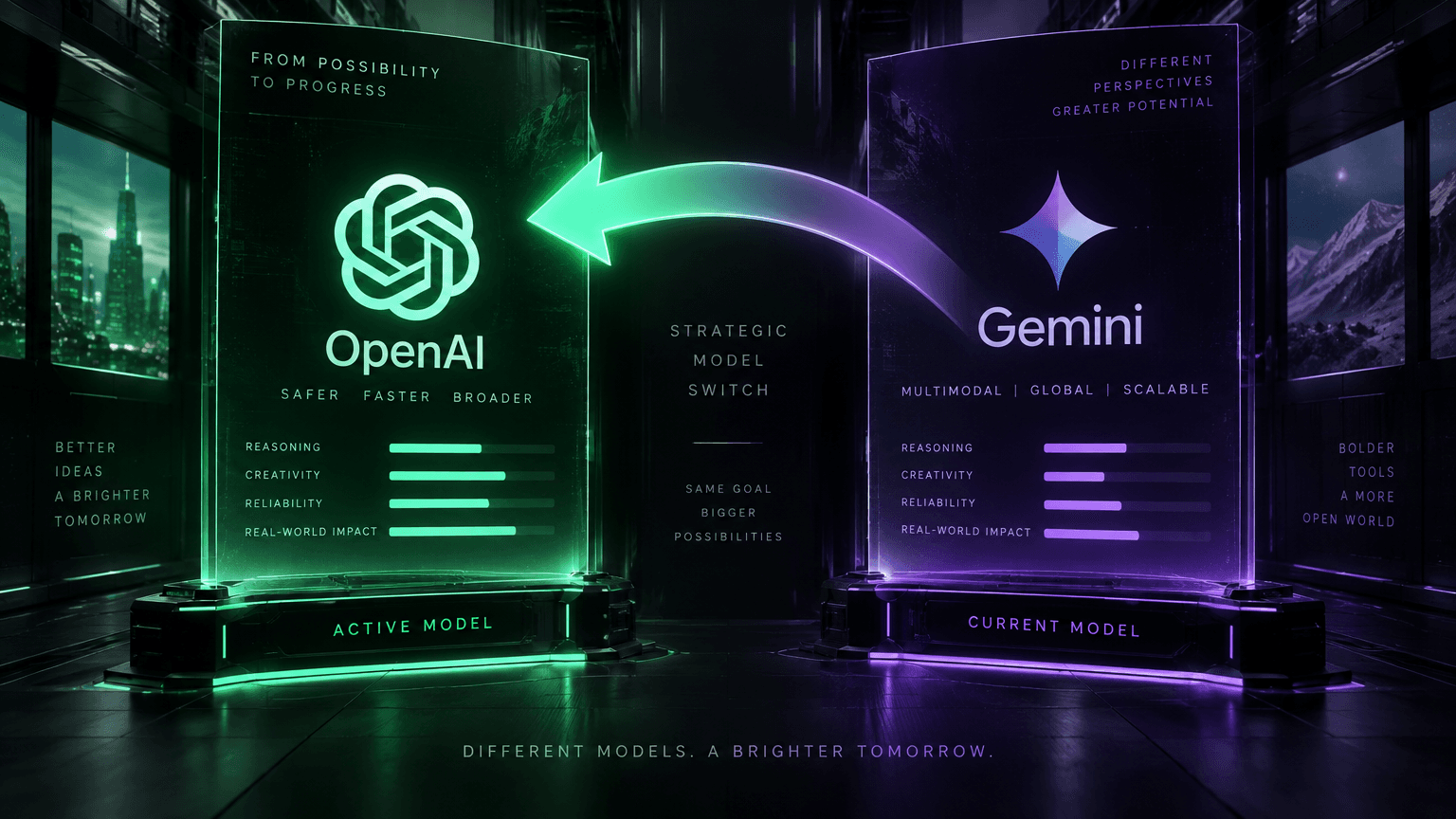
Replit's CEO announced the switch in October 2026, citing two main factors: a 30% discount offered by OpenAI, and stronger enterprise support infrastructure as Replit's customer mix shifted dramatically toward enterprise.
The scale of that shift is notable. Enterprise revenue grew from 2% to over 50% of Replit's total revenue — a transformation that changed what Replit needed from a model provider. Individual developers and small teams have different requirements from enterprise IT buyers. Enterprise customers want volume pricing, dedicated support, data processing agreements, SLA commitments, and confidence that the vendor will be there in five years.
Replit concluded that OpenAI's enterprise offering better matched those requirements, and that a 30% model cost reduction at their usage scale was material.
The story is not that OpenAI "won" or that Anthropic's models are worse — Anthropic's Claude models remain competitive on coding and reasoning tasks. The story is that model capability was not the deciding factor. Commercial terms and enterprise infrastructure were.
The pattern this reveals
Replit is not unique. Similar decisions are playing out across the enterprise software market.
Businesses that adopted AI tools in 2023–2024 made choices based on what was available and which models performed best on capability benchmarks. Those decisions are now being revisited as AI usage scales from experimental to operational, and as the commercial reality of running AI at enterprise scale becomes clear.
Three factors are driving these re-evaluations:
Cost at scale. A model that costs $0.01 per thousand tokens is negligible for a prototype. At 100 million tokens per month — a realistic volume for a product with meaningful usage — the cost is $1,000 per month. At a billion tokens, it is $10,000. These are material operating costs, and a 30% discount from one provider versus another is a significant budget line. Enterprise AI buyers are starting to negotiate volume pricing the same way they negotiate software licences.
Enterprise support quality. When AI is embedded in production workflows, downtime or degraded performance has business consequences. Enterprise buyers need SLAs, dedicated support contacts, incident escalation paths and contractual uptime commitments. Not all AI providers offer the same quality of enterprise support, and the gap becomes visible when something goes wrong at 2 AM on a Tuesday.
Compliance and data governance. Regulated industries — financial services, healthcare, legal — have strict requirements about where data is processed, who can access it, and how long it is retained. Some AI providers offer stronger compliance documentation and data processing agreements than others. For businesses in regulated sectors, compliance terms can outweigh capability differences.
The model selection mistake businesses make
The most common mistake businesses make when selecting an AI model provider is optimising for benchmark performance on tasks that are not their tasks.
General AI benchmarks test a wide range of capabilities across many domains. They are useful for understanding what models can do in theory. They are not reliable predictors of which model will perform best in your specific workflows, on your specific data, with your specific prompt patterns.
The right approach is to run a structured evaluation on your own tasks:
- Define three to five representative tasks that represent the highest-volume or highest-stakes AI work in your product or workflow
- Prepare a test set of 50–100 real inputs for each task
- Run each candidate model through all test sets with your actual prompts
- Score outputs on the criteria that matter for your use case (accuracy, format compliance, latency, cost per output)
- Factor in commercial terms, compliance fit and vendor stability before making a final decision
Capability is one input. It is rarely the only input that matters at enterprise scale.
The lock-in risk no one talks about enough
When Replit switched from Anthropic to OpenAI, it was able to do so. That suggests Replit's AI architecture was designed with some model flexibility — otherwise the switching cost would have been prohibitive.
Many businesses are not in that position. They have built application logic that relies on specific model behaviours, prompts that work because of idiosyncrasies of one provider's API, or integrations that assume specific response formats. Switching providers becomes a major engineering project.
The architectural principle that protects against this is straightforward: your AI application logic should not know which model it is calling. Build against an abstraction layer — a thin wrapper, a configuration-driven model selector, or a managed inference layer like LiteLLM — that lets you change the underlying model by changing a configuration value, not by rewriting application code.
This does not prevent you from using model-specific features when they offer real advantages. It means you design those uses as isolated, replaceable components rather than distributed throughout your codebase.
What this means if you are currently choosing an AI model provider
If you are choosing a model provider for a new AI product or workflow, the Replit case suggests asking these questions before you make a final decision:
What does this cost at 10x my current usage? Model pricing that looks manageable today may be the biggest line item in your operating budget at scale. Get clarity on volume pricing early.
What happens when something breaks in production? Test the vendor's support responsiveness before you are dependent on it. Submit a test support ticket during your evaluation.
What are the data processing terms? Read the data processing agreement, not just the marketing copy. Know where your data is processed, how long prompts and responses are retained, and what happens to your data if you cancel.
How hard would it be to switch? Architecture your integration now so that switching providers later is a configuration change, not a rewrite.
Who is this vendor in three years? The AI model market is consolidating. Vendors may merge, pivot or exit. Assess vendor stability alongside capability.
Related reading
- Microsoft Copilot Gets an Autopilot Mode: How the largest enterprise AI platform is shifting from assistant to agent — and what deployment looks like in practice.
- US Government Bans DeepSeek from Federal Agencies: Why AI vendor provenance is becoming a procurement variable — and how to audit your current stack.
- Nvidia GTC Berlin 2026: AI Factory and OpenShell: How infrastructure choices interact with model provider decisions at enterprise scale.
How AleyaAI can help
AleyaAI builds AI integrations and products and custom AI development using a model-agnostic architecture that keeps switching cost low and compliance documentation clear. We work with OpenAI, Anthropic, and other enterprise-grade providers, and we run structured model evaluations on your specific tasks before recommending a stack.
If you are re-evaluating your AI model provider, planning to scale an existing AI product, or starting a new AI integration and want guidance on model selection, book a free 30-minute strategy call.
Want this working in your business? We build it end to end.
See how we build it