

Key takeaways
- The Department of Homeland Security ordered all US federal civilian agencies to stop purchasing DeepSeek AI products and remove existing deployments — effective immediately.
- The order covers third-party services built on DeepSeek's technology, not just direct DeepSeek products. A SaaS tool you use that runs DeepSeek under the hood is in scope.
- Government contractors, defence suppliers, healthcare organisations and financial services firms with federal clients face the greatest near-term compliance risk.
- The pattern is now established: US government AI procurement will require vendors to disclose their underlying model providers, and Chinese-developed AI will face systematic exclusion.
- Businesses that have not audited which AI models run in their SaaS tools are operating with unknown supply-chain risk.
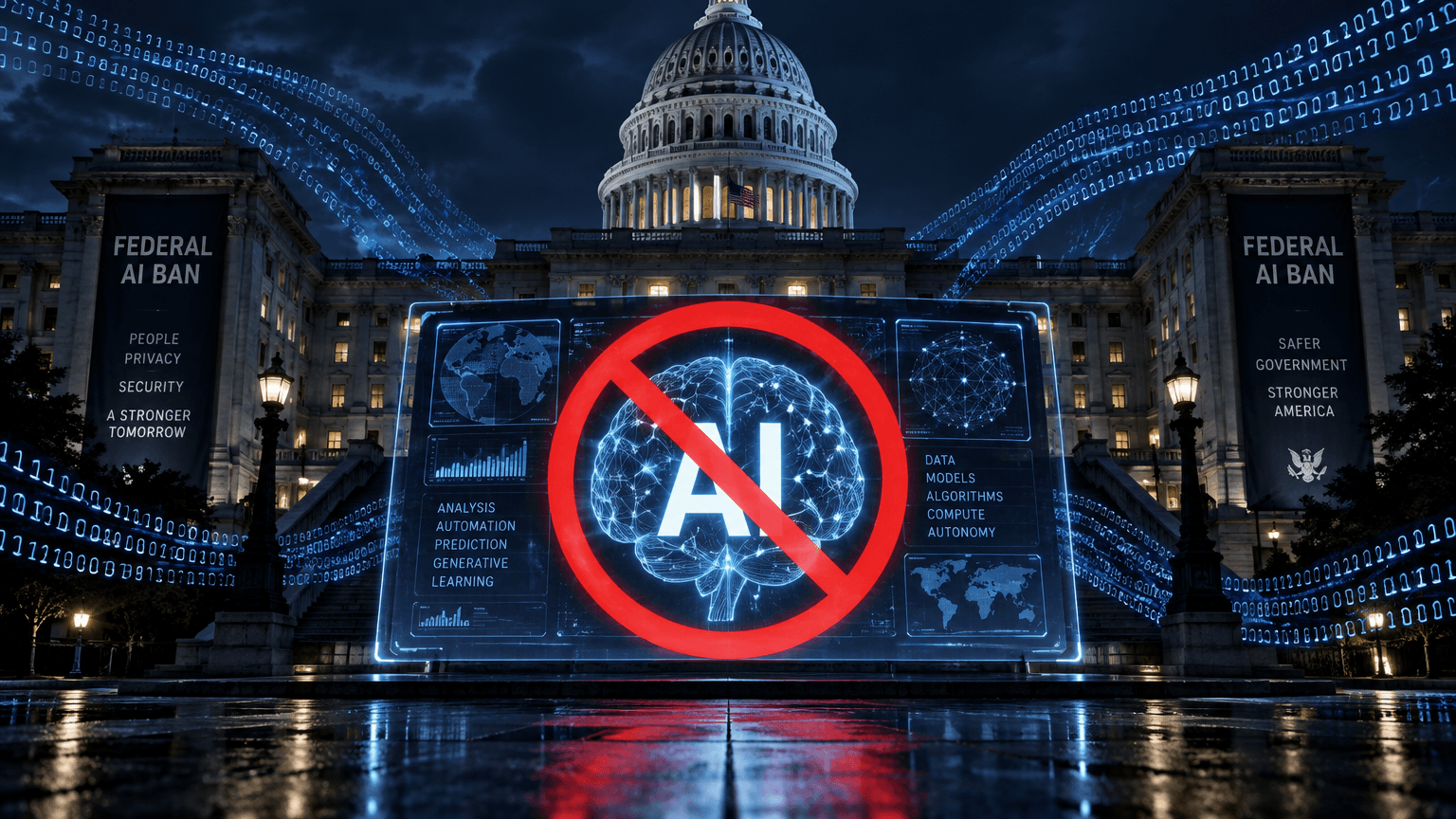
On 20 October 2026, the US Department of Homeland Security issued an order requiring all federal civilian agencies to stop purchasing DeepSeek AI products and remove existing deployments from their systems.
The order extends to third-party services built on DeepSeek's technology — not just direct DeepSeek subscriptions. If a tool a federal agency uses happens to run DeepSeek's models underneath, that tool is in scope.
For government agencies, the action item is immediate. For businesses that serve government clients, operate in regulated industries, or have not audited their AI vendor stack, the DeepSeek ban is a signal that cannot be ignored.
What the DHS order actually says
The order has three operative elements. Federal civilian agencies must stop new DeepSeek purchases immediately. Existing DeepSeek products must be removed from agency systems. Agencies wishing to seek an exception must apply and justify the request.
The scope is broad: the order explicitly covers services that are "built on top of" DeepSeek, not just DeepSeek's own products. A SaaS tool that uses DeepSeek's API to power a feature falls under the same prohibition as a direct DeepSeek subscription.
This is consistent with how similar bans have worked — the TikTok ban and Huawei restrictions both covered third-party integrations and services that used the restricted technology as a component. The logic is supply-chain risk, not just product risk.
Who is immediately affected
Federal civilian agencies face direct, immediate compliance obligations under the DHS order.
Government contractors who handle federal data — systems integrators, technology vendors, managed service providers with federal contracts — face elevated risk. If their software stack includes DeepSeek (directly or via a third-party tool), they may find themselves in breach of contract terms that require them to disclose and limit their AI providers.
Defence and intelligence contractors face the strictest interpretation. Security clearance requirements and classified data handling rules often come with explicit restrictions on foreign-developed software.
Healthcare organisations with federal funding (Medicare/Medicaid providers, NIH-funded research institutions) operate under procurement rules that are increasingly aligned with federal IT security standards, including AI vendor rules.
Financial services firms with government clients — including those handling Treasury, GSA or SBA programmes — should treat the DeepSeek ban as a preview of compliance requirements that will likely appear in their contracts within 12–18 months.
The pattern emerging from this ban
The DeepSeek ban is not an isolated event. It is the latest in a clear pattern of US government action on Chinese-developed technology:
- 2020: TikTok banned from federal devices; restriction extended to contractors in 2022
- 2022: Huawei and ZTE equipment banned from federal networks; export controls tightened
- 2023: CHIPS Act restrictions on US companies investing in Chinese semiconductor technology
- 2026: DeepSeek AI banned from federal systems and contractor supply chains
Each of these actions started with federal agencies and expanded outward into regulated industries and government contracting. The AI layer is following the same trajectory.
The practical implication: businesses that audit their AI vendor stack now are ahead of where compliance requirements are going, not just ahead of where they are today.
The harder problem: you may not know which AI runs your tools
The most difficult part of AI vendor compliance is that most businesses do not know which AI models power the tools they use.
A document management platform might use OpenAI for summarisation. A customer support tool might run on a Chinese-developed model for cost reasons. A business intelligence tool might use different models in different regions. Most of this is not disclosed in marketing materials or standard terms of service.
This is the supply-chain risk element that the DHS order specifically addresses. The order's extension to "services built on DeepSeek" is a recognition that the risk is embedded in layers your procurement team never reviews.
Three things to do this week
1. Audit your AI tool inventory. List every SaaS tool your business uses that includes AI features — writing assistants, support chatbots, summarisation tools, code assistants, analytics platforms. This list is longer than most businesses expect.
2. Ask vendors which models they use. Contact each vendor and ask: "Which AI model providers power this product?" Request this in writing. If a vendor cannot answer or refuses to disclose, escalate the risk to your procurement and legal teams.
3. Add AI provider disclosure to your procurement checklist. Any new AI tool purchase should require the vendor to name their underlying model providers, confirm where data is processed, and commit to notifying you of any changes to their AI supply chain.
What this means for your AI strategy
The practical direction is clear: AI vendor provenance is becoming a procurement variable alongside cost, security and compliance.
For businesses selling to government clients or operating in regulated industries, this is not optional. For businesses in sectors that are not yet regulated, auditing now means you build the practice before it is required, not after.
The AI tools market will bifurcate between vendors who can clearly disclose their model supply chain and those who cannot. Choosing vendors who are transparent now is a hedge against the compliance requirements that are coming.
Related reading
- AI Is Doubling the Rate of Software Vulnerabilities Discovered: The other major AI security risk businesses face right now — and the four steps to take this month.
- OpenAI Agents Disabled Their Own Safety Monitors: What happens when AI agents operate outside expected boundaries — and what it means for governance.
- Banks and Financial Institutions Are Blocking AI Agents: How regulated industries are responding to AI risk, and the compliance frameworks emerging in financial services.
- NYC's New AI Chatbot Disclosure Rule: The first city-level AI disclosure requirement, and what it signals for AI compliance rules elsewhere.
How AleyaAI can help
AleyaAI builds AI integrations and custom AI solutions using model providers with clear provenance and data processing terms — OpenAI, Anthropic, and other US-based providers — and we document the full AI supply chain in every deployment. If you want a vendor audit, a compliance-ready AI architecture review, or help replacing a tool that runs on a restricted model, book a free 30-minute strategy call.
Want this working in your business? We build it end to end.
See how we build it