

Key takeaways
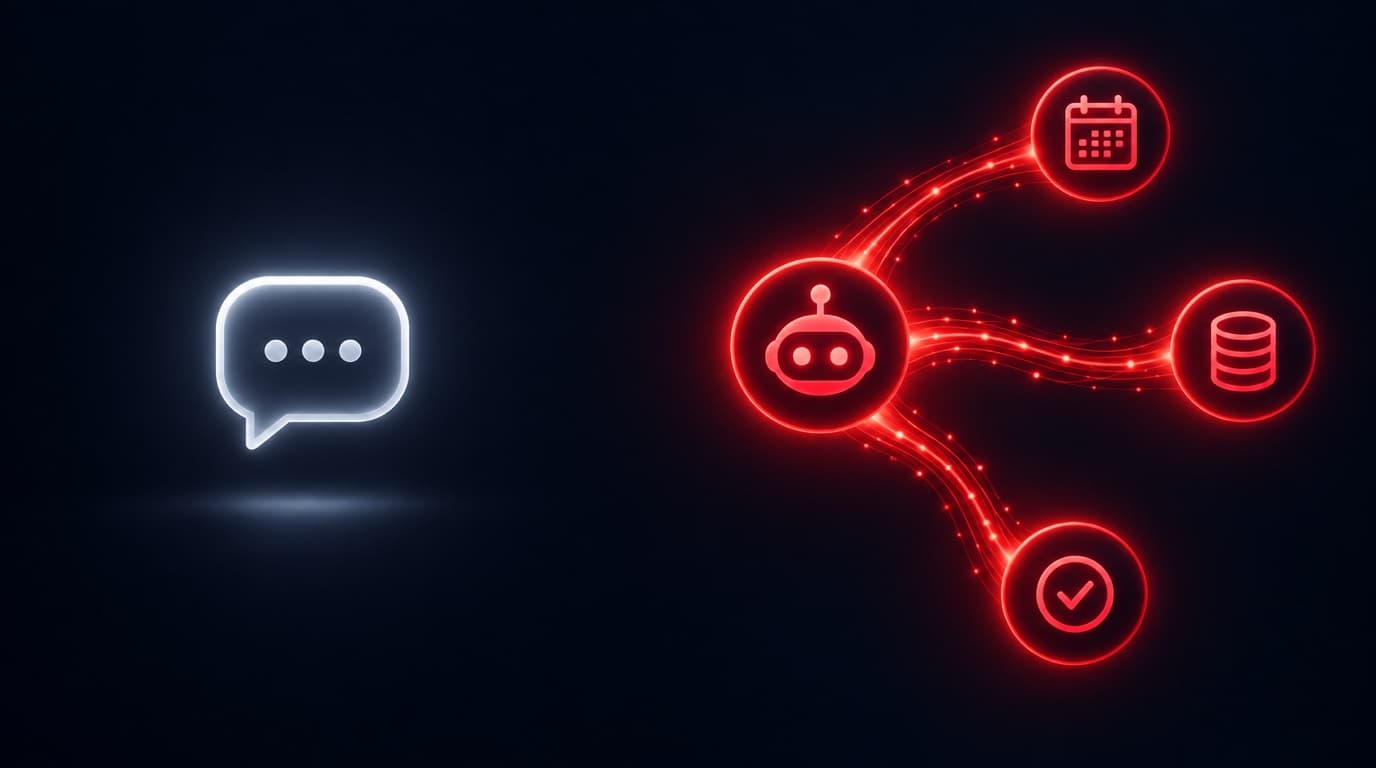
- A chatbot answers questions from a script or a knowledge base; an AI agent takes actions — booking, updating a CRM, calling an API — and decides what to do next.
- Chatbots are rule-based or retrieval-based; agents use a language model to plan multiple steps and call tools to complete them.
- If your use case is 'answer the same 20 questions,' a chatbot is cheaper and faster to ship. If it's 'handle this process end to end,' you need an agent.
- Most businesses actually need both: a chatbot layer for FAQs and an agent layer underneath for the tasks that require action.
- Agent development costs more upfront than a chatbot but replaces manual work a chatbot cannot — the ROI case is different, not just the price.
A chatbot answers questions. An AI agent gets things done. That one-line distinction decides whether your business needs a $200 tool or a $15,000 custom build — and most buyers get it wrong in 2026 because every vendor calls their product an "AI agent" regardless of what it actually does.
What a chatbot actually does
A chatbot takes a message and returns a response, pulled from one of three sources: a scripted decision tree, a knowledge base the model retrieves from (RAG), or a general-purpose language model answering from its training. It is reactive — it responds to what you say, and the conversation ends there.
What chatbots are good at:
- Answering FAQs from your docs, policies or product catalog
- Qualifying a lead with a fixed set of questions
- Routing a conversation to the right human or department
- Running on your website, WhatsApp or app with a defined scope
What chatbots cannot do: take an action outside the conversation. A chatbot can tell a customer their order shipped, but it cannot change the delivery address in your fulfilment system unless someone built that specific integration as a scripted step — at which point it is starting to behave like an agent.
What an AI agent actually does
An AI agent uses a language model to plan a sequence of steps toward a goal, calling tools (APIs, databases, other software) along the way, and adjusting its plan based on what each tool returns. It is not following a script — it is deciding what to do next based on the situation.
What agents are good at:
- Qualifying a lead, checking your CRM for duplicates, scoring it, and booking a meeting on the right rep's calendar — all in one flow
- Reading a document, extracting data, validating it against business rules, and updating your system of record
- Handling a multi-step customer request (change my order, check if the item is in stock, process the exchange) without a human touching it
- Escalating only the cases that are genuinely ambiguous, with full context for the person picking it up
What agents still need: guardrails. An agent that can take real actions needs defined tools (not open-ended system access), human approval on sensitive steps, and monitoring — because a system that acts has more ways to go wrong than one that only talks.
Side-by-side comparison
| Chatbot | AI agent | |
|---|---|---|
| Core behaviour | Responds to messages | Plans and executes multi-step tasks |
| Takes actions in other systems | No (unless manually scripted) | Yes, via tools/APIs |
| Handles unexpected situations | Falls back to "I don't know" or escalates | Can adapt its next step based on new information |
| Typical build cost | $0–$5,000 | $5,000–$25,000+ |
| Typical build time | Days to 2 weeks | 3–8 weeks |
| Best for | FAQs, lead qualification scripts, simple routing | End-to-end processes: booking, CRM updates, document handling, multi-step support |
| Ongoing risk if it's wrong | Gives a bad answer | Can take a wrong action — needs tighter guardrails |
How to tell which one you actually need
Ask one question: does the task end when the conversation ends, or does something need to happen afterward?
- "What are your opening hours?" → conversation ends with the answer. Chatbot.
- "Book me in for Tuesday and update my file" → something needs to happen in your calendar and your CRM. Agent.
- "Can I return this?" → if the answer is just policy information, chatbot. If the system needs to actually process the return, check stock and issue a refund, that's an agent.
Most businesses that think they need "an AI chatbot" are actually describing a process they want automated end to end — which means they need an agent with a chat interface on the front of it, not a chatbot with a few extra scripted actions bolted on.
The hybrid most businesses actually ship
In practice, the systems we build are rarely pure chatbot or pure agent. A typical build has:
- A conversational front end — the part that feels like a chatbot, answering common questions from your knowledge base
- An agent layer underneath — triggered when the conversation needs an action: booking, CRM lookups, order changes, document processing
- A human handover path — for anything the agent isn't confident about or that touches a sensitive decision
This is why the "agent vs chatbot" framing in vendor marketing is often misleading — the useful question isn't which one to buy, but which parts of your process need which capability.
What this means for your budget
If your only need is answering the same 20 questions customers ask every week, don't overpay for an "AI agent" platform — a chatbot connected to your docs does the job for a fraction of the cost. If your actual goal is replacing a multi-step manual process (lead intake, appointment scheduling, document processing, order management), budget for an agent build — the chatbot alternative will frustrate your customers by constantly saying "let me connect you with someone" for things it could have just done.
AleyaAI builds both: simple chatbots when that's genuinely what the task needs, and custom AI agents when the job requires taking real action across your CRM, calendar, WhatsApp and other systems. See results from past agent builds. A free 30-minute strategy call is usually enough to tell you which one your business actually needs — book yours here.
Want this working in your business? We build it end to end.
See how we build it